$46,762,258 from 17,822 people. That is what Anker’s eufyMake E1 UV printer raised on Kickstarter in 2025, making it the most funded campaign in Kickstarter history. Its goal was $500,000. It hit $1 million in about a minute.
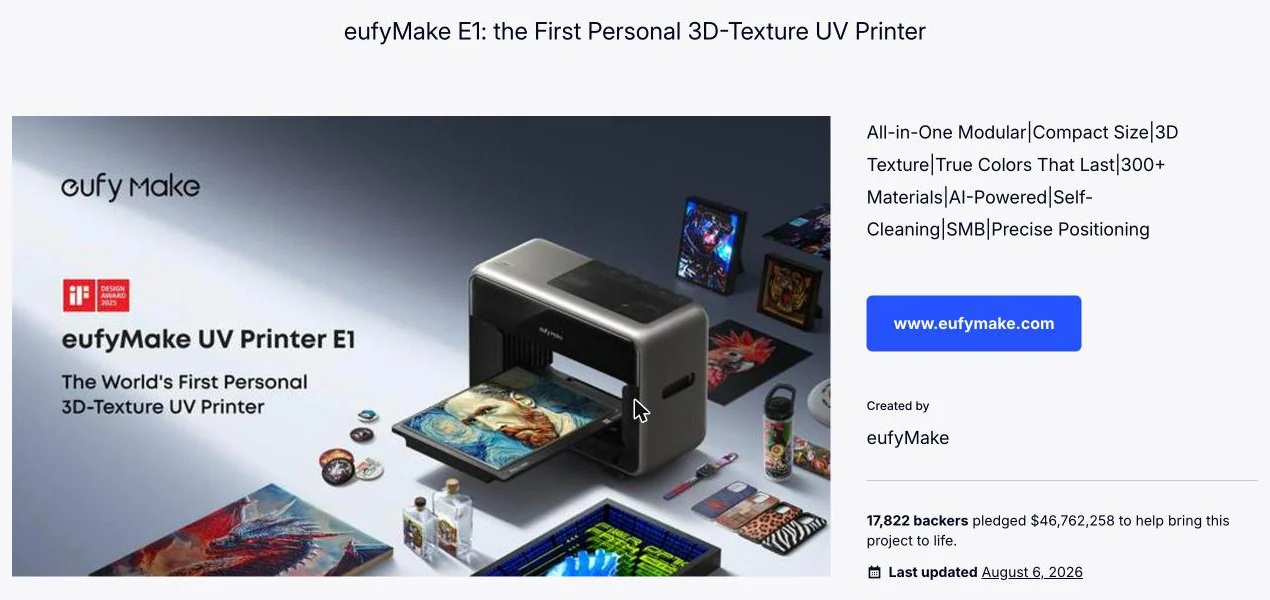
Anker is a multi-billion-dollar company. It did not need the money. So why launch a high-end printer on a crowdfunding site, and what did it get that a normal launch would not have given it?
The numbers first
| Measure | eufyMake E1 |
|---|---|
| Raised | $46,762,258 |
| Backers | 17,822 |
| Goal | $500,000 (funded 9,352%) |
| Average pledge | about $2,624 |
| First $1 million | about one minute after launch on 29 April 2025 |
| Previous record | Brandon Sanderson’s Four Secret Novels |

An average pledge of about $2,600 is not impulse buying. These were people who had decided before the page went live.
Who is eufyMake?
eufyMake is Anker’s brand for makers. Its first product, sold as AnkerMake, was the M5 3D printer, which raised $8,879,417 on Kickstarter. Until 2023 the team kept working on that kind of printer: the standard type that builds objects from melted plastic.
At the end of 2023 it stopped. In an internal review the team put two new ideas to Anker’s leadership, who asked them to pick one and gave them three more months to prove it. They chose UV printing, because the user research behind it was strongest. Cheney Xie, who leads product and R&D at eufyMake, put the gap simply: a 3D printer makes the shape and a laser engraver cuts, but neither adds colour. A UV printer prints full colour, with raised texture, onto things people already own: wood, metal, leather, glass, phone cases, tumblers.
The problem was price. Industrial UV printers cost RMB 100,000–200,000, roughly $14,700–29,400, and are big industrial machines. eufyMake set out to make one for a tenth of that price that fits on a desk. In Xie’s words: “Industrial specialization is designed for large-scale business, but our users are long-tail creators.”
Getting there took close to 200 review meetings, three redesigns of the machine’s core layout, and its own printhead control board after a supplier quoted RMB 40,000 for a part with about RMB 400 of components in it. To test the 3D texture feature, Xie took samples to Dafen, China’s oil-painting village, and watched painters react to them.
Before launch: the demand was built first
The $1 million in the first minute was the result of three things eufyMake did in the weeks before launch.
A paid deposit, not just an email list
eufyMake unveiled the E1 on 15 April 2025, two weeks before the campaign, and took $50 refundable deposits on its own website. Backers who put down a deposit and then pledged on Kickstarter got $200 off the early-bird price or $400 off the standard price, plus their $50 back after shipping.
A deposit is a much stronger signal than an email sign-up. Someone who pays $50 two weeks early has already decided. It also told eufyMake how big launch day would be before it happened, and those deposit holders were the people waiting with the page open at launch.
Working makers, not tech reviewers
Anker’s earlier printer relied on mainstream tech influencers. For the E1, eufyMake targeted crafters and small businesses instead. The campaign page leads with YouTube makers who use tools to earn money: BitnerBuilt (who also interviewed Cheney Xie), Red Rocking Bird, Make or Break Shop, Sawdust and Splinters, SteveMakesEverything and Six Eight Woodworks.
The quotes on the page are about business, not specs. SteveMakesEverything says that when he showed printed samples to customers, “they were throwing orders at me”. For a buyer weighing a $2,000 machine, that line from a working maker is worth more than any spec sheet.
A clear price anchor
Every bundle came with two Kickstarter prices, a limited early-bird price and a higher “KS Special” price, and Creative Bloq reported an expected retail price of $2,499. Backers could see three prices and knew which one was the deal.
The rewards: how the pricing worked
These are the eight bundles on the campaign’s Rewards tab, with the number of backers who chose each one.
| Reward | Price | Backers |
|---|---|---|
| Early bird: Basic bundle | $1,699 | 2,214 |
| Early bird: E1 + Rotary attachment | $1,970 | 3,696 |
| Early bird: E1 + UV DTF laminator | $1,970 | 2,126 |
| Early bird: Deluxe bundle | $2,552 | 7,970 |
| KS Special: Basic bundle | $1,899 | 231 |
| KS Special: E1 + Rotary attachment | $2,170 | 342 |
| KS Special: E1 + UV DTF laminator | $2,170 | 249 |
| KS Special: Deluxe bundle | $2,752 | 664 |

Four things stand out.
1. The most expensive bundle was the most popular
The early-bird Deluxe bundle, the priciest early-bird option at $2,552, was chosen by 7,970 backers: nearly half of everyone who picked a bundle. It came with the printer, both flatbeds, ink, the rotary attachment, the laminator and a full material kit, and the page told backers they were saving $1,202 (32%). When the biggest bundle carries the biggest saving, it becomes the obvious choice.
2. Nine in ten backers took an early-bird price
16,006 of the 17,492 bundle backers paid an early-bird price. The early-bird tiers had visible limits: 8,561 Deluxe bundles and 4,100 Rotary bundles. A “591 left” counter gives people a reason to pledge today rather than next week.
3. The friction was removed
Every bundle included free shipping to the US, Canada, the EU, the UK and Hong Kong, with customs fees and VAT covered, plus a one-year warranty. Hidden import costs put off international backers of expensive hardware. Covering them removed the last reason to wait.
4. Add-ons added $7.6 million
The bundles alone add up to about $39.1 million at their listed prices. The other $7.6 million was pledged on top: ink and cleaning kits, flexible white ink, hot-foil stamping, material kits, a large-format bundle and even a second printer at $30 off. Ink is the part that keeps selling after the campaign: a single 100 ml cartridge costs $42.99.

Bundle totals are each reward’s price multiplied by its backer count. The Rewards tab counts 17,492 bundle backers; the page total of 17,822 includes backers not counted against these eight rewards.
The 60 days, step by step
| Late 2023 | The team drops standard 3D printers and commits to UV printing. |
| 15 April 2025 | The E1 is unveiled, with $50 deposits on eufyMake’s website. |
| 29 April 2025 | The Kickstarter launches with a $500,000 goal and reaches $1 million in about a minute. |
| May–June 2025 | Stretch goals are met and new accessories and bundles are added: a roll-to-film attachment, flexible white ink and hot-foil stamping. |
| 24 June 2025 | Kickstarter announces the E1 as its most funded project ever, passing Brandon Sanderson’s $41.75M. |
| 28 June 2025 | The campaign closes at $46,762,258 from 17,822 backers. |
| July 2025 | Estimated delivery on the reward pages. |
| By May 2026 | Overseas delivery nearly complete, after a production fault held up shipments. The E1 goes on sale in China. |
Along the way the campaign posted 27 updates and collected more than 16,000 comments. New accessories added mid-campaign gave backers a reason to come back and add to their pledge, and gave the press a new story to write.

1. Kickstarter was the launch, not the funding
For a big company, crowdfunding is a launch channel with three things a normal launch does not have: a built-in audience of early adopters, a hard deadline that creates urgency, and a public number that keeps going up. The rising total became the story, which brought more press, which brought more backers.
The lesson: pick a launch platform for its audience and its countdown, not just for the money.
2. It validated the product before the page went live
Anker’s team interviewed more than 50 makers, surveyed more than 2,000 people and invited nearly 100 key opinion consumers into a project group, even visiting their homes to watch them use prototypes. By launch day it knew who the buyer was: long-tail creators and small businesses that can earn back the cost by selling what they print.
The lesson: the most expensive products need the most proof before launch. Put your first users in a group, watch them use it and use their words on the page.
3. It sold the business case, not the machine
The marketing leaned on what the printer earns, such as “a dollar’s worth of ink on a custom metal sign”. For a small business owner, a printer that pays for itself is an investment, not a toy. That is how you get an average pledge of $2,600.
The lesson: if your buyer can make money with your product, show them the maths on the first screen.
4. The first minute was planned weeks earlier
$1 million in about a minute does not happen by luck. It happens when thousands of people are waiting with the page open at 10pm on launch day. That takes a pre-launch list, reminders, and a reason to back on day one rather than day ten.
The lesson: the launch is won before it starts. Build the waitlist, count it, and only set the date when the list is big enough to fund the goal in the first hours.
5. It learned from its own earlier crowdfunding
Anker’s first 3D printer also set a crowdfunding record, but mass production and delivery ran into problems. By late 2023 the team had decided to drop its standard 3D printers and focus on UV printing. Delivery of the E1 was nearly complete about a year after launch.
The lesson: a record campaign is only good if you can deliver it. Backers remember delivery longer than they remember launch day.
What happened after the campaign
During mass production the team found a fault: small tolerances in the mould for one ink tank meant a small chance of ink leaking, which only showed up after long use. Shipments were held. According to KrASIA, engineers slept in the factory for about a month, checked units one by one, and remade the mould and the affected parts. Before shipping restarted, they stress-tested 100 machines and printed several tonnes of ink.
The reward pages had promised July 2025. Overseas delivery was nearly complete by spring 2026. eufyMake also added a printhead protection plan, eufyMake Care, which sends a free replacement printhead if one fails within a year.
The campaign also created a category. KrASIA reports that xTool and Bambu Lab are now developing UV hardware. A record campaign tells competitors where the demand is, so the first-mover advantage lasts only as long as delivery and support stay good.
How we’d run this campaign today
Most brands don’t have Anker’s budget, but nearly everything that worked here scales down. If we were running a hardware launch like this now, this is the plan.
- Take paid reservations, not just emails. A small refundable deposit ($1–$50, depending on price) on your own site shows who is really buying. Set the Kickstarter goal at what those reservations will fund in the first hour.
- Seed 10–20 working creators eight weeks out. Choose people whose audience buys tools to make money, not general tech reviewers. Embargo their videos to launch morning and put their best lines on the page.
- Design the top bundle first. Decide what you want most people to buy, give it the biggest saving, and price the smaller bundles so the big one looks like the obvious choice.
- Cap early birds with real numbers. Visible limits (“591 left”) turn interest into a pledge today.
- Remove the hidden costs. If you can, include shipping and import taxes in the price for your main countries. International backers of expensive products drop out over surprise fees.
- Save news for the middle of the campaign. Add an accessory or a new bundle in weeks two to six. It gives you something to announce, a reason to email backers, and a lift in pledges during the slow middle.
- Treat consumables as the business. Price add-ons such as refills, materials and spares so backers stock up during the campaign, then carry on selling after it.
- Don’t promise a delivery month until a pilot batch has been stress-tested. eufyMake’s ink leak only appeared after long use. A few hundred machines running for weeks before you set the date is cheaper than a year of apology updates.
What to copy at £5K, £50K and £500K
| Budget | What to do |
|---|---|
| £5K | Ten customer interviews, a small group of early users, a landing page that collects emails, and a launch date only when the list is big enough. |
| £50K | All of the above, plus paid ads to grow the waitlist, creators showing the product earning money, and PR planned for launch week. |
| £500K | A full pre-launch programme with a community of early users, launch-day ads in several countries and a delivery plan you are confident in before you launch. |
Questions founders ask
Is Kickstarter still worth it for small brands?
Yes, if you build the audience first. Kickstarter rewards campaigns that arrive with their own crowd.
How big should the waitlist be?
Big enough to hit your goal in the first day or two. Work it out from your price and how many people on the list usually back.
Does a high price hurt on Kickstarter?
Not when the buyer can see the return. The E1’s average pledge was about $2,600.
What did the eufyMake E1 cost on Kickstarter?
Early-bird bundles started at $1,699 for the basic bundle and went up to $2,552 for the Deluxe bundle. Standard Kickstarter prices were $200 higher.
Which eufyMake E1 bundle was most popular?
The early-bird Deluxe bundle at $2,552, chosen by 7,970 backers, nearly half of all bundle backers.
What not to copy
- Launching on a big number you cannot deliver.
- Setting a launch date before the waitlist is ready.
- Selling specs when the buyer cares about what the product earns them.
Kickstarter is a launch channel. Use it like one.
AnkerMake M5: Anker’s first record
Anker’s first 3D printer, the AnkerMake M5, raised $8,879,417 in 2022 and was the most funded 3D printer on Kickstarter until the Snapmaker U1 in 2025.

How it compares with other record campaigns
| Campaign | Platform | Year | Raised | Backers | Goal |
|---|---|---|---|---|---|
| EufyMake E1 (Anker) | Kickstarter | 2025 | $46,762,258 | 17,822 | $500,000 |
| Brandon Sanderson | Kickstarter | 2022 | $41,754,153 | 185,341 | $1M |
| Pebble Time | Kickstarter | 2015 | $20,338,986 | 78,471 | $500,000 |
| Snapmaker U1 | Kickstarter | 2025 | $20,161,265 | 20,206 | n/a |
| Coolest Cooler | Kickstarter | 2014 | $13,285,226 | 62,642 | n/a |
| Flow Hive | Indiegogo | 2015 | $12M+ | ~25,000 orders | A$70,000 |
| Exploding Kittens | Kickstarter | 2015 | $8,782,571 | 219,382 | $10,000 |
| Star Citizen | Kickstarter + own site | 2012– | $2,134,374 on Kickstarter; $1B+ total sales | n/a | n/a |
| Frosthaven | Kickstarter | 2020 | $12,969,608 | 83,193 | n/a |
| Kingdom Death: Monster 1.5 | Kickstarter | 2016–17 | $12,393,139 | 19,264 | $100,000 |
| Peak Design Travel Tripod | Kickstarter | 2019 | $12,143,435 | 27,168 | $500,000 |
| Critical Role: Vox Machina | Kickstarter | 2019 | $11,385,449 | 88,887 | $750,000 |
| Ouya | Kickstarter | 2012 | $8,596,474 | 63,416 | $950,000 |
| Fidget Cube | Kickstarter | 2016 | $6,465,690 | 154,926 | n/a |
| Oculus Rift | Kickstarter | 2012 | $2,437,429 | 9,522 | n/a |
Totals at campaign close. Some campaign pages now show more, from pledges taken after the campaign ended.
More breakdowns in our campaign teardowns.
Planning a launch like this? We have run Kickstarter and Indiegogo marketing since 2015 and helped creators raise $150M+. Book a free discovery call or see our Kickstarter agency service.
Sources: Kickstarter, EufyMake’s printer sets a new crowdfunding record; KrASIA, Inside Anker’s push to turn UV printing into a consumer product; TechRadar, Anker’s 3D printer becomes the most popular Kickstarter ever ; KrASIA, Inside Anker’s push to turn UV printing into a consumer product ; eufyMake launch press release, 29 April 2025 ; All3DP, EufyMake’s record-breaking campaign ends this weekend ; Creative Bloq, This UV printer just broke a Kickstarter world record ; the campaign’s Kickstarter Rewards tab (11 November 2026). The average pledge and bundle totals are calculated from the campaign’s own figures.
Free: Kickstarter launch checklist
Everything to do in the 12 weeks before launch, on launch day and after. Two pages, free.
What a Kickstarter agency costs
Agency fees, ad budgets and platform fees explained.
More tips & advice

Secure your FREE discovery call with us today.
Our crowdfunding marketing agency works with clients worldwide so no matter where you are we can help. We work with all types of business from small to large, so no matter your budget we can help.
If you have any issues please email directly samit@samitpatel.net
Please Note
We only take on 5 new crowdfunding clients every quarter every client gets carefully screened to make sure we can 100% deliver. It is important you provide as much information as possible and get in contact with us EARLY.
- You
- Your project
- Budget