
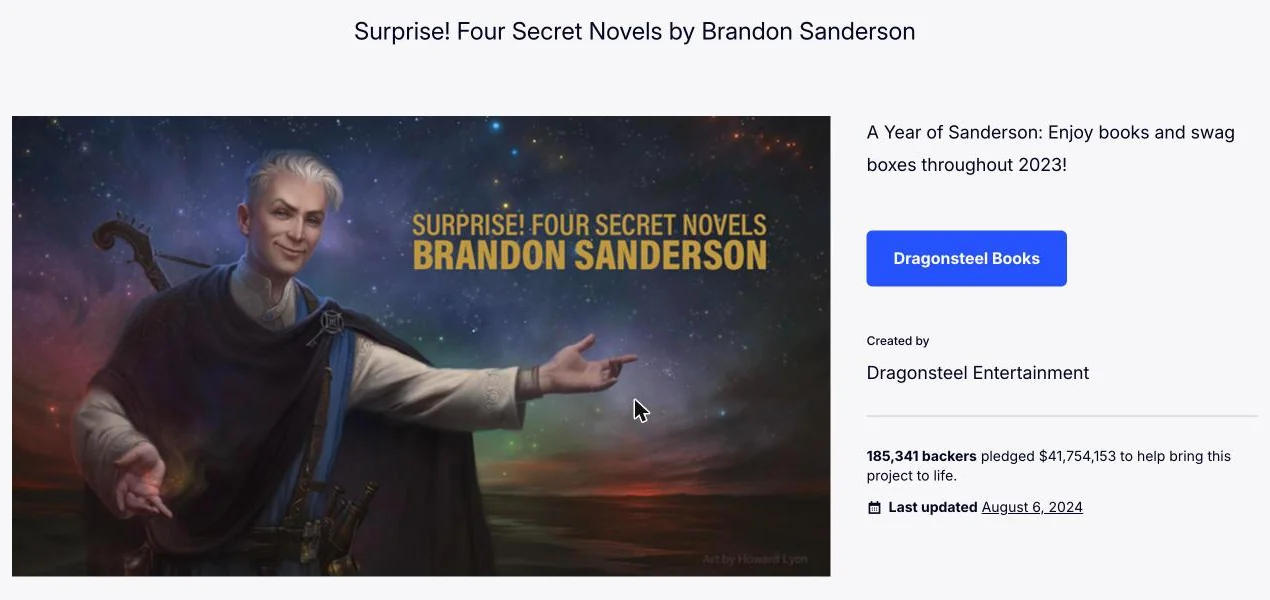
Brandon Sanderson’s 2022 Kickstarter raised $41.7 million from 185,341 backers in 30 days, against a $1 million goal. It passed $15 million on day one, passed the previous record, Pebble Time’s $20.3 million, in three days, and stayed the most funded Kickstarter until 2025. It was also, on purpose, a surprise: there was no pre-launch page at all.
The numbers
| Raised | $41,754,153 |
| Backers | 185,341 |
| Goal | $1 million |
| Funding period | 1 March – 1 April 2022 (30 days) |
| Day one | More than $15 million |
| Previous record passed | Pebble Time, $20.3M, within three days |
| Rewards | Eight tiers, from $40 to $500 |
| Earlier campaign | 2020: $6.7M from nearly 30,000 backers for a leather-bound The Way of Kings |
| Kickstarter’s 5% fee | More than $2 million |

The backstory
Sanderson is one of the best-selling fantasy authors alive. He has published more than 50 books since 2005, and his main series, The Stormlight Archive and Mistborn, are published by Tor. Before the pandemic he spent more than 100 days a year travelling for events. In 2020 that stopped, and he started writing a secret novel as a gift for his wife, Emily. Then he wrote another, and another. By 2022 he had four finished novels nobody knew about.
He already had his own company, Dragonsteel, and a track record on Kickstarter: in 2020 a leather-bound tenth-anniversary edition of The Way of Kings raised $6.7 million from nearly 30,000 backers. So he didn’t sell the four books to a publisher. He sold them directly to readers.
He gave two reasons. First, a Kickstarter is a pre-order: it tells you exactly how many copies to print. Second, his online shop could sell books already in stock, but it couldn’t run a year-long subscription without the set-up and tracking a campaign provides. In a later interview he was blunter: he has “huge problems with Amazon”, and for years he had tried to get publishers to offer editions at several price points, without success.

Before launch: there wasn’t one
Most record campaigns spend months building a pre-launch list. Sanderson’s launched on the same day it was announced, with a YouTube video on his own channel. The secret was the hook: four novels nobody had heard of, from an author whose fans read everything he writes.
This only worked because the pre-launch had been happening for 17 years. His readers already followed his YouTube channel and blog, and nearly 30,000 of them had backed one of his campaigns before. A surprise launch is a way to spend an audience, not to build one. For anyone without that audience, the lesson is to build the list first.
The campaign page
Titles kept secret, then revealed weekly
The page didn’t name the books. Readers who wanted to go in blind could; everyone else got a new video every week in March in which Sanderson revealed one title and read from the first chapters. That turned a 30-day campaign into four weekly events, each with a reason to come back, talk about it and share it.
Thank-you gifts instead of stretch goals
There were no stretch goals. Instead, the team announced four “thank you gifts” on weekly livestreams:
- dual-colour printing inside every premium hardcover;
- a bookmark in the first box, plus Dragonsteel covering customs and taxes for international backers;
- a digital art package for every backer;
- a Cosmere character pin set, one pin in each of the twelve boxes.
Stretch goals often add costs the creator hasn’t priced in. Gifts the team had already planned and costed gave backers the same weekly reveals without that risk.
Collectable, one-off editions
The premium hardcovers were described in detail: about 400 pages, a leather-look cover, colour illustrations, designed endpapers, a sticker and a bookmark with every shipment. The page also warned that the premium edition “might not be available again”. Collectors don’t wait when they’re told a run is limited.
The rewards: who paid what
These are the eight rewards on the campaign’s Rewards tab and the number of backers who chose each one. “Quarterly books” sent one book every three months in 2023. “A Year of Sanderson” added a themed swag box in each of the eight months without a book.
| Reward | Price | Backers |
|---|---|---|
| Quarterly books: ebook | $40 | 44,430 |
| Quarterly books: audiobook | $60 | 40,681 |
| Quarterly books: premium hardcover | $160 | 49,491 |
| Quarterly books: all formats | $220 | 11,463 |
| A Year of Sanderson: ebook | $360 | 2,370 |
| A Year of Sanderson: audiobook | $380 | 4,095 |
| A Year of Sanderson: premium hardcover | $480 | 8,656 |
| A Year of Sanderson: all formats | $500 | 23,103 |

A cheap way in made the backer count huge
The $40 ebook tier brought in 44,430 backers. It’s a small amount each, but every backer adds to the total, the headline count and the momentum that brought in the next wave.
A subscription for superfans made the total huge
About one in five backers, 38,224 people, chose a “Year of Sanderson” tier at $360–$500. At listed prices those tiers add up to about $18.1 million, more than the other 146,065 backers combined. The best-selling single tier at that level was the most expensive one: 23,103 people paid $500 for everything.

Shipping paid up front
Shipping was charged per month, $10 domestic and $35 international, and paid at pledge time. With twelve shipments a year, that is a big part of the roughly $9 million pledged on top of the listed reward prices. Charging it up front meant the cost of a year of posting was covered before the first box went out.
Reward totals are each tier’s price multiplied by its backer count. The Rewards tab counts 184,289 backers across the eight tiers.
The 30 days, step by step
| 2020 | Leather-bound The Way of Kings raises $6.7M from nearly 30,000 backers. |
| 1 March 2022 | The campaign launches with a YouTube announcement and a $1M goal. |
| Day one | More than $15 million pledged. |
| Within three days | Passes Pebble Time’s $20.3M to become the most funded Kickstarter ever. |
| Each week in March | A new book title is revealed with a reading on YouTube; a new thank-you gift is announced on the livestream. |
| 1 April 2022 | Closes at $41,754,153 from 185,341 backers. |
| 2023 | One novel each quarter, starting with Tress of the Emerald Sea in January, and swag boxes in the months between. |
| June 2025 | The EufyMake E1 passes the record. |
What happened next
Dragonsteel ran fulfilment itself, from a warehouse in American Fork, Utah. Sanderson said the company had to double its staff to do it. At one point the team was packing a single month’s box for more than 38,000 backers on its own assembly line, which matches the 38,224 “Year of Sanderson” backers. Delivery was slow and uneven for some backers, and the company has since moved into a warehouse with about ten times the space.
Two admissions are worth knowing. Sanderson said that, after the cost of fulfilment, the campaign didn’t earn him more than selling the books through a New York publisher would have. And he regretted that independent bookshops were left out. The campaign’s value was control and the direct relationship with readers, not a bigger margin.
The model has carried on: his Cosmere roleplaying game raised $15.15 million on Kickstarter in 2024.
The money, in plain numbers
$41.75 million is the headline, not what landed in Dragonsteel’s bank account. Here is roughly how the first deductions look, using Kickstarter’s 5% platform fee and its standard US payment-processing rate of 3% plus $0.20 per pledge (you can run your own numbers in our Kickstarter fee calculator):
| Total pledged | $41,754,153 |
| Kickstarter’s 5% fee | about $2.09 million |
| Payment processing (3% + $0.20 × 185,341 pledges) | about $1.29 million |
| Left before printing, boxes, postage and staff | about $38.4 million |
Out of that came four premium hardcover print runs, ebook and audiobook production, eight months of swag boxes, a year of postage to about 70 countries and territories, and a warehouse team that doubled in size. That is why Sanderson said the campaign didn’t earn him more than a traditional deal would have. The average pledge was about $225, but a $500 backer receives twelve parcels, and every parcel costs money to make and send.
The lesson for any creator: price your rewards from the full cost of delivering them, including fees, packaging, postage and the people who pack them, not from the headline you hope to reach.
Why it worked
1. An audience built over years
The campaign didn’t create demand. It captured demand Sanderson had built over 17 years, through his books, his blog and his YouTube channel.
2. A test run first
The 2020 campaign raised $6.7 million. It gave the team proof that fans would pledge, and two years of experience in running and fulfilling a campaign before going far bigger.
3. A secret, revealed in instalments
“Secret novels” is a hook in itself, and revealing one title a week kept the story alive for the whole month instead of just launch day.
4. Tiers for every kind of fan
A $40 entry point for the curious and a $500 year-long subscription for superfans, with clear steps in between. Each type of fan could pledge exactly what they wanted.
What not to copy
- A surprise launch without an audience. With no list, a surprise is just a quiet launch.
- Doing a year of monthly fulfilment yourself unless you are ready to hire for it. Sanderson had to double his staff.
- Leaving your other sales channels out. If retailers sell your product, tell them your plans before you launch.
How we’d run it today
Few product creators have Sanderson’s readership, but his playbook works for anything with fans: board games, gear, collectables, consumer hardware. This is how we’d adapt it.
- Turn your audience into a list you own. Social followers aren’t a launch list. Move them to email and a community months before launch.
- Run a smaller campaign first. A limited edition or accessory campaign proves demand and trains your team, then the big launch builds on those backers.
- Build a superfan tier. A bundle, collection or year-long subscription at three to ten times your entry price. In this campaign, one backer in five paid for more than half of the reward money.
- Keep the entry tier cheap. A low-cost tier (a digital version, an accessory, an early-bird single unit) maximises backer count, and backer count drives the headlines.
- Plan four weekly reveals. A new feature, bundle, colourway or gift each week gives you emails, updates and press angles for the whole campaign.
- Use gifts instead of stretch goals when a stretch goal would add costs you haven’t priced in.
- Charge shipping in the pledge and price it from real quotes, especially for international and multi-shipment rewards.
- Decide fulfilment before launch. Use a fulfilment partner unless you already run a warehouse team, and say who is shipping on the page.

How it compares with other record campaigns
| Campaign | Platform | Year | Raised | Backers | Goal |
|---|---|---|---|---|---|
| EufyMake E1 (Anker) | Kickstarter | 2025 | $46,762,258 | 17,822 | $500,000 |
| Brandon Sanderson | Kickstarter | 2022 | $41,754,153 | 185,341 | $1M |
| Pebble Time | Kickstarter | 2015 | $20,338,986 | 78,471 | $500,000 |
| Snapmaker U1 | Kickstarter | 2025 | $20,161,265 | 20,206 | n/a |
| Coolest Cooler | Kickstarter | 2014 | $13,285,226 | 62,642 | n/a |
| Flow Hive | Indiegogo | 2015 | $12M+ | ~25,000 orders | A$70,000 |
| Exploding Kittens | Kickstarter | 2015 | $8,782,571 | 219,382 | $10,000 |
Totals at campaign close. Some campaign pages now show more, from pledges taken after the campaign ended.
More breakdowns in our campaign teardowns.
Frequently asked questions
How much did Brandon Sanderson raise on Kickstarter?
$41.7 million from 185,341 backers in 2022, the Kickstarter record until the EufyMake E1 in 2025.
What was the Brandon Sanderson Kickstarter for?
Four secret novels written during the pandemic, released through 2023, with optional monthly boxes of themed items.
What was the goal?
$1 million.
How much was Brandon Sanderson’s Kickstarter on day one?
More than $15 million on its first day, 1 March 2022.
What were the reward tiers?
Eight tiers from $40 (four ebooks) to $500 (all formats plus eight monthly swag boxes). The $160 premium hardcover tier had the most backers: 49,491.
Planning a launch like this? We have run Kickstarter and Indiegogo marketing since 2015 and helped creators raise $150M+. Book a free discovery call or see our Kickstarter agency service.
Sources
- CNBC: Author’s record-breaking Kickstarter closes at $41.7 million
- Kickstarter: EufyMake breaks the all-time funding record
- SYFY: Brandon Sanderson crowdfunds $15 million in a day
- Publishers Lunch: Sanderson’s Kickstarter makes $15 million in one day
- Welcome to Brandon Sanderson’s fantasy empire
- The campaign’s Kickstarter page and Rewards tab (11 November 2026)
Free: Kickstarter launch checklist
Everything to do in the 12 weeks before launch, on launch day and after. Two pages, free.
Kickstarter marketing agency
Crowdfunding marketing since 2015, with $150M+ raised for Kickstarter and Indiegogo creators.
More tips & advice

Secure your FREE discovery call with us today.
Our crowdfunding marketing agency works with clients worldwide so no matter where you are we can help. We work with all types of business from small to large, so no matter your budget we can help.
If you have any issues please email directly samit@samitpatel.net
Please Note
We only take on 5 new crowdfunding clients every quarter every client gets carefully screened to make sure we can 100% deliver. It is important you provide as much information as possible and get in contact with us EARLY.
- You
- Your project
- Budget